

Imagine waking up on a chilly morning in Simi Valley or Thousand Oaks, expecting a cozy home, but instead, you’re met with a draft that feels like an air conditioner. It’s a sinking feeling when you realize your furnace blowing cold air is the reason your living room feels like a walk-in cooler. You aren’t just shivering; you’re likely worrying about unexpected repair bills or whether your family is safe. We know that pit-in-your-stomach feeling, and we want to help you get your comfort back as quickly as possible.
We believe home maintenance should be simple and transparent. In this guide, you’ll discover the most common reasons your heater is acting up and learn which simple fixes you can handle yourself. We’ll walk you through everything from basic thermostat settings to air filter checks and pilot light troubleshooting. By the time you’re done reading, you’ll know exactly how to restore the warmth to your home and when it’s truly necessary to call in a neighborly expert for a professional repair.
Key Takeaways
- Recognize that a few minutes of cool air is often just a normal warming-up period for older heating systems.
- See why a clogged air filter might be the reason for your furnace blowing cold air by triggering a safety shutdown to protect your home.
- Identify signs of mechanical trouble, such as a dirty flame sensor, which can cause your heater to shut off before the house gets warm.
- Know exactly which simple fixes you can handle yourself and when it’s safer to let a local expert manage complex gas or electrical repairs.
- Understand how proactive maintenance helps families in Simi Valley and Thousand Oaks avoid the stress of a sudden winter heater failure.
Why Is My Furnace Blowing Cold Air? The First Checkpoints
Finding your furnace blowing cold air when you’re trying to stay warm is more than just a minor inconvenience; it’s genuinely stressful. You might worry about a broken system or a massive repair bill right when you need your heater most. Before you assume the worst, please know that this is one of the most common calls we receive in Simi Valley and Thousand Oaks. Often, the solution is much simpler than a full system replacement. It helps to understand that your heater is a complex machine with safety protocols designed to protect your home. Sometimes, what feels like a failure is actually just a setting or a brief delay in the heating process. We want to help you identify these “quick fixes” so you can get back to your day without unnecessary anxiety.
The “Fan ON” Setting Trap
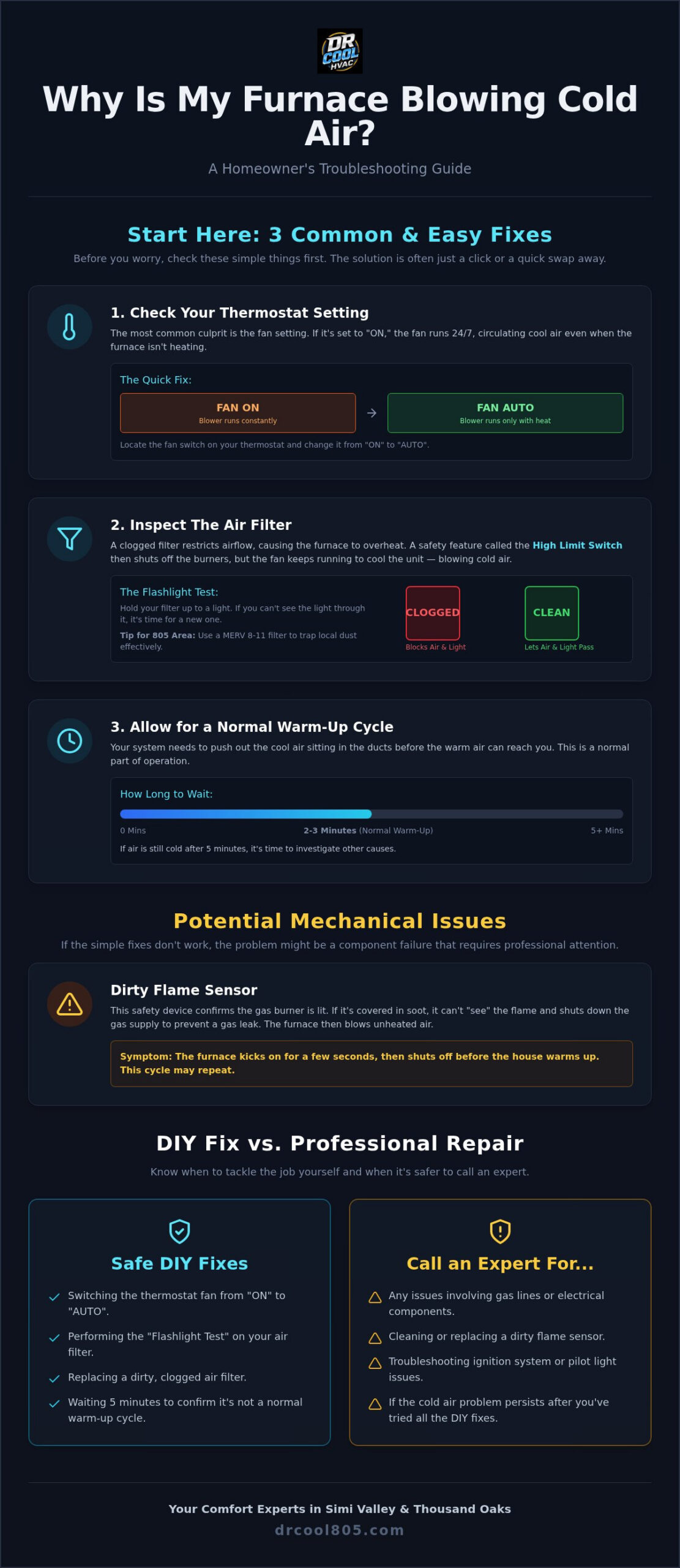
The most frequent reason for a furnace blowing cold air is actually a simple thermostat setting. Most thermostats have two fan settings: “ON” and “AUTO.” If your thermostat is set to “ON,” the blower fan will run continuously, even when the furnace burners aren’t actually heating anything. This keeps air moving through your home to improve circulation, but once the heat cycle ends, that air will feel room-temperature or even drafty. This air isn’t technically “chilled” like an AC, but because it’s moving, it feels much colder against your skin. Understanding how forced-air systems work can help you see why the fan and the heating elements operate on separate schedules. To fix this, follow these steps:
- Locate the “Fan” switch on your thermostat interface.
- Check if the indicator points to “ON” or “AUTO.”
- Switch the setting to “AUTO” to ensure the fan only runs when heat is being produced.
Normal Warm-Up Cycles
Think of your furnace like a bathroom faucet. When you turn on the hot water, you usually have to wait a few moments for the cold water trapped in the pipes to wash away. Your HVAC system works the same way. When the heat kicks on, the fan has to push out the cool air that’s been sitting in your ducts since the last cycle. For older systems, this “warming up” period can last between two and three minutes. “A furnace warm-up cycle is simply the process of clearing cool, stagnant air from your ductwork before the heated air can reach your living space.” If you still feel a chilly breeze after five minutes of operation, then it’s time to look deeper into potential troubleshooting issues. Truly cold air, similar to the temperature outside, usually indicates the burners aren’t igniting at all, which we will explore in the next sections.
Sometimes your heater isn’t actually broken; it’s simply being protective. For neighbors in Simi Valley or Thousand Oaks, the culprit is often the very air we breathe. Our local Santa Ana winds carry fine dust and microscopic debris that can coat a filter much faster than the standard three-month recommendation suggests. When your filter is choked with this local grit, your system struggles to breathe. This leads to a safety cycle that often results in your furnace blowing cold air. It’s a frustrating experience, but it’s actually a sign that your system’s safety features are working exactly as they should to keep your home safe from mechanical failure or fire hazards.
Understanding the High Limit Switch
The high limit switch acts as a dedicated guardian for your furnace’s heat exchanger. When airflow is restricted by a thick layer of dust, the heat generated by the burners has nowhere to go, causing temperatures inside the cabinet to spike rapidly. Increased static pressure from a clogged filter prevents efficient heat transfer, triggering the high limit switch to shut down the burners to prevent a cracked heat exchanger. While the burners turn off to stop the heat, the blower fan stays on. This fan serves as the “cooling crew,” running at full speed to pull away the dangerous excess heat. Because the burners are off, that blower fan is just circulating unheated air through your vents, which explains why you feel a chilly draft instead of warmth.
Checking and Replacing Your Filter
The first step to restoring your comfort is a simple visual inspection. You can perform the “flashlight test” by holding your filter up to a bright light. If the light can’t pass through the mesh, air certainly can’t either. It should look clean and white, not gray and fuzzy. For homes in the 805 area, we recommend using filters with a MERV rating of 8 to 11. This range is effective at trapping local dust and allergens without forcing your system to work too hard. If you’ve replaced the filter and still experience issues, it might be time for a professional heating repair checkup to ensure the limit switch hasn’t been damaged by repeated overheating. Keeping a fresh filter is the best way to prevent your furnace blowing cold air during our occasional cold snaps.
Mechanical Failures: Flame Sensors and Ignition Issues
If you’ve checked your thermostat and replaced your filter but still find your furnace blowing cold air, the issue might be hidden behind the service panel. Your furnace has a sophisticated sequence of events that must happen perfectly for heat to reach your vents. At the heart of this process is a small but vital component called the flame sensor. This thin metallic rod acts as a safety scout, confirming that a flame is actually present before allowing the gas valve to stay open. If this sensor is dirty or faulty, it fails to send that “all clear” signal to the control board. The system then shuts off the burners to prevent unburned gas from entering your home, while the blower fan continues to push unheated air through the house.
This situation often leads to a frustrating cycle known as “short cycling.” You might hear the furnace click, see the glow of the ignitor, and even feel a brief burst of warmth. However, if the flame dies out after just a few seconds, the sensor is likely the culprit. Over time, moisture in the air and carbon buildup from the combustion process create a thin layer of oxidation on the sensor. In areas like Thousand Oaks, where seasonal humidity shifts occur, this buildup is a very common maintenance hurdle.
The Dirty Flame Sensor Dilemma
A dirty flame sensor is one of the most frequent reasons for a mid-winter service call. Because it’s constantly exposed to high heat, the metal eventually develops a coating that insulates it from the flame it’s supposed to detect. While it might seem like a simple part to clean, these sensors are incredibly fragile. Even a small crack in the porcelain housing or using the wrong abrasive material can ruin the component entirely. We often find that a professional cleaning as part of a regular maintenance routine is the safest way to ensure your system recognizes the flame and keeps the heat flowing without interruption. A thorough professional furnace inspection includes cleaning these sensitive components before they cause a mid-season breakdown.
Pilot Lights and Ignitors
The way your furnace starts the fire depends on its age. Older systems rely on a standing pilot light, which is a small, constant flame. If this light goes out due to a draft or a faulty thermocouple, the furnace won’t light, leaving you with cold air. For modern high-efficiency systems, a hot surface ignitor (HSI) does the work. These function much like the filament in an old lightbulb, glowing white-hot to ignite the gas. These ignitors are prone to cracking as they age, especially after years of expansion and contraction. If you’re dealing with an older unit, you might want to learn more about what to do when your furnace pilot light goes out before assuming you need a major repair. Whether it’s a flickering pilot or a cracked HSI, identifying the ignition source is a key step in stopping that chilly breeze.
When to Call DR COOL: DIY vs. Professional Repair
Deciding when to pick up the tool bag and when to pick up the phone can be a tough call. We understand the anxiety that comes with home maintenance; you want to save money, but you also want your family to stay safe and warm. As your local neighbors in the 805, we believe in honesty first. We’d much rather you find a simple flipped switch on your own than pay for a service call you didn’t actually need. However, when a furnace blowing cold air involves high-voltage electricity or natural gas, the boundary for DIY work becomes very clear. Safety is always the priority.
The “Safe for DIY” Checklist
Before you assume your system has reached the end of its life, walk through these basic checkpoints. These are simple, non-invasive steps that every homeowner in Simi Valley or Oxnard can perform safely.
- Check the Circuit Breaker: Sometimes a power surge or a heavy load can trip the furnace’s dedicated switch. If the breaker is in the “off” position, flip it back once. If it trips again immediately, stop and call for a professional diagnostic.
- Verify the Gas Valve: Ensure the handle on your gas line is turned to the “ON” position, parallel to the pipe. If it was accidentally bumped into the “OFF” position, your burners won’t have fuel to ignite.
- The Reset Button Protocol: Many furnaces have a red reset button on the blower motor. It’s okay to press this once to see if the system restarts. If the system shuts down again, don’t keep pressing it. Repeated resets can cause unburned gas to build up, creating a safety hazard.
Signs of a Professional Emergency
While we encourage checking the basics, certain symptoms require an expert’s touch. If you notice a distinct smell of “rotten eggs,” this is the scent of mercaptan, a chemical added to natural gas to help you detect leaks. If you smell this, leave the house immediately and call your gas provider. Other red flags include loud booming noises when the furnace tries to ignite or visible soot around the furnace cabinet. As we discussed earlier, a furnace blowing cold air often results from repeated limit switch trips. If this happens frequently, it indicates a deeper airflow or mechanical issue that could lead to a cracked heat exchanger if left unaddressed. For these complex technical issues, our team provides reliable heating repair to restore your peace of mind and home comfort. If you want to understand the full scope of what a technician evaluates during a service visit, our guide on central heat repair in the 805 walks through the diagnostic process in detail.
Restoring Comfort in the 805 Area
Your home should be your sanctuary, especially when the temperature drops in Simi Valley or Thousand Oaks. Dealing with a furnace blowing cold air is a disruption to that peace. We don’t just see a mechanical problem; we see a family that isn’t as comfortable as they should be. Our team at DR COOL is deeply rooted in the 805 area, and we treat every service call as an opportunity to help a neighbor. Whether you’re in a classic home in Oxnard or a newer build in Camarillo, we understand the specific nuances of local HVAC systems and how our unique coastal and valley climates impact them. We’re here to ensure you don’t have to face the winter chill alone.
Neighborly Service for Simi Valley and Beyond
Our approach is different from the cold, clinical style of big corporations. We take an unhurried, methodical path to diagnostics. This means we listen to your concerns first. We look at the whole system to find the root cause rather than just treating the symptoms. If you’ve tried the DIY steps mentioned earlier and still feel a chill, it’s time to let a professional take a look. Our technicians are familiar with the specific dust and wind patterns that affect homes from Ventura to Thousand Oaks. You can schedule your furnace inspection with DR COOL today to get a clear, honest assessment of your heater’s health.
Preventative Care for Your Furnace
The best way to handle a furnace blowing cold air is to prevent it from happening in the first place. Seasonal maintenance is more than just a checklist; it’s a way to extend the life of your equipment and keep your utility bills manageable. During a professional inspection, we clean those sensitive flame sensors, check the high limit switches, and ensure your heat exchanger is intact. This proactive care removes the “cold air” surprise from your winter season. It gives you the peace of mind that comes with knowing your system is prepared for whatever the weather brings.
We want you to feel confident in your home’s reliability. Our goal is to move you from a state of uncertainty to a state of total resolution. When your heater is running smoothly, you can stop worrying about the mechanics and get back to enjoying the warmth of your home. We’re here as your steady, knowledgeable guide, acting as a helpful partner to keep your property safe and cozy. You can trust us to provide the individualized care you deserve.
Get Ready for a Warm and Cozy Winter
A chilly draft in your home can be unsettling, but now you have the tools to identify why you’re dealing with a furnace blowing cold air. From checking your thermostat’s “Auto” setting to replacing a dust-clogged filter, many solutions are well within your reach. Understanding how your system protects itself through safety shutdowns gives you the clarity to act without fear. If those simple fixes don’t restore the heat, it’s a sign that your system needs the individualized care only a professional can provide.
As a locally owned business, we take pride in offering neighborly service and expert diagnostics to our friends in Simi Valley and Thousand Oaks. We focus on integrity, ensuring you only pay for the repairs your home truly needs to stay safe. You don’t have to shiver through another night of uncertainty. Get your heat back-Contact DR COOL HVAC for expert repair in the 805 area. We’re here to be your helpful partner in home comfort. Rest easy knowing that warmth is just a phone call away.
Frequently Asked Questions
Is it safe to run my furnace if it is blowing cold air?
It is usually safe to let the fan run if the issue is a simple thermostat setting, but you should turn the system off if you suspect a mechanical failure. A furnace blowing cold air often means a safety sensor has already stopped the heating process to protect your home. If you notice unusual noises or repeated shutdowns, it is best to keep the system off until a professional can verify that the heat exchanger is functioning correctly.
How much does it typically cost to fix a furnace blowing cold air?
Repair costs vary based on the specific component that has failed. According to national industry data from 2026, a simple flame sensor cleaning or replacement might range from $75 to $200, while a new ignitor typically costs between $150 and $300. More complex issues, like a blower motor or control board failure, can reach $400 to $900. We always recommend a professional diagnostic to get an accurate estimate for your specific system’s needs and local labor rates.
Why does my furnace blow cold air for a few minutes then turn off?
This behavior is a classic sign of “short cycling,” which usually happens when a safety sensor detects a problem. If your air filter is clogged, the system may overheat and trigger the high limit switch to kill the burners. Alternatively, a dirty flame sensor might fail to detect a flame, causing the system to shut down after just a few seconds of operation. Checking your filter is the best first step to resolve this frustrating pattern.
How do I reset my furnace after it blows cold air?
You can usually reset your furnace by flipping the power switch on the side of the unit off and back on, or by pressing the raised red button on the blower motor. It is important to only attempt a reset once. If the system continues to blow cold air or shuts down again immediately, it means a safety device is still detecting a fault. Repeatedly resetting a malfunctioning furnace can lead to more significant damage or safety hazards for your family.
Can a dirty air filter really cause my furnace to blow cold air?
Yes, a dirty air filter is one of the most common reasons for this issue. When the filter is clogged with dust, it restricts the airflow needed to cool the heat exchanger. This causes the internal temperature to rise too high, triggering a safety switch that shuts off the burners while keeping the blower fan running to cool the system down. Replacing your filter every 90 days, or more often during windy Santa Ana conditions, prevents this.
What should I do if I smell gas while my furnace is blowing cold air?
If you smell a “rotten egg” odor, you must leave your home immediately and call your local gas utility provider from a safe distance. Do not flip any light switches, use a phone inside the house, or attempt to turn off the furnace yourself, as these actions could create a spark. This smell indicates a potential gas leak, which is a serious safety emergency that requires professional intervention from utility experts before you re-enter the property.
How often should I have my furnace inspected in the 805 area?
We recommend having your furnace professionally inspected once a year, ideally in the early autumn before the first cold snap hits Simi Valley or Thousand Oaks. Regular maintenance helps catch small issues like dirty sensors or worn ignitors before they lead to a complete system failure. In our local 805 climate, seasonal inspections also ensure that dust from the dry summer months hasn’t compromised your indoor air quality or your system’s overall heating efficiency.
Why is my thermostat set to 70 but the house is 62 and the air is cold?
This discrepancy suggests that while your thermostat is calling for heat, the furnace is failing to deliver it. The system may be in a “lockout” mode after several failed ignition attempts, or the blower fan might be running in the “ON” position without the burners firing. If your furnace blowing cold air persists despite the thermostat’s request, it usually points to a mechanical failure like a faulty ignitor or a tripped safety switch that requires an expert diagnostic.