
Imagine waking up on a crisp morning in Thousand Oaks, reaching for your thermostat, and realizing the familiar hum of your heater has been replaced by an icy silence. It’s a stressful moment that many homeowners in the 805 area worry about as the seasons change. You might feel anxious about potential fire hazards or fear being pressured into buying a brand new system when a simple fix would do. We believe you deserve to feel confident and safe in your own home without the stress of a clinical, corporate sales pitch.
The good news is that your heating system usually provides plenty of warnings before it fails completely. This guide will help you identify the subtle signs furnace needs repair so you can catch malfunctions early, protect your family, and keep your energy bills under control. We’ll walk you through seven specific sensory cues, ranging from odd noises to fluctuating temperatures, that help you distinguish between normal operation and a genuine need for professional heating repair. By the end, you’ll have the peace of mind to handle the winter months with total confidence and a clear plan of action.
Key Takeaways
- Learn to interpret your furnace’s “language” by identifying specific sounds and smells that signal mechanical stress before a complete breakdown occurs.
- Discover why recognizing the early signs furnace needs repair, such as short-cycling or uneven heating in your home, can prevent expensive cascade failures.
- Apply the “50% Rule” to determine if a repair is a wise investment or if it’s time to consider a more efficient heating system for your household.
- Understand how a simple seasonal inspection provides peace of mind by catching safety hazards like electrical issues or burner malfunctions early.
Why Listening to Your Furnace Saves You Money in the Long Run
We understand that hearing a new clunk or hiss coming from the hallway closet can feel like a heavy burden. It’s natural to worry about the potential cost or the fear of being pressured into a system replacement you don’t actually need. Think of this as a neighborly check-in; home maintenance is definitely a task, but it stays manageable when we take it step by step. By paying attention to how your system sounds and feels today, you can avoid the stress of a total breakdown later.
Your furnace is a complex machine where every part relies on the next. When a small component like a blower belt begins to fray, it creates extra friction and heat. That minor stress eventually forces the blower motor to work twice as hard, leading to a total motor failure that costs significantly more to fix. Catching these early signs furnace needs repair allows you to replace a simple part before it triggers a domino effect through the whole system. Even in places like Simi Valley and Thousand Oaks, where our winters are often mild, your furnace still goes through significant wear during those chilly nights. Proactive care is always more affordable than a reactive repair call during the first real cold snap of the year.
The Cost of Procrastination in Home Heating
When a furnace is dirty or neglected, it struggles to pull in air, which places immense pressure on the heat exchanger. This component is the heart of your heater; if it overheats too often, it can crack or fail prematurely. Short-cycling is when your furnace turns on and off in rapid, inefficient bursts, which significantly inflates your monthly electricity bill while wearing out the internal switches. Ignoring these small hiccups often leads to a total system lockout exactly when you need the warmth most. Staying ahead of these issues keeps your monthly costs predictable and your home comfortable.
Safety First: Beyond Just Comfort
Beyond the financial aspect, your furnace plays a critical role in keeping your family safe. A properly functioning system manages combustion gases and vents them safely outdoors. However, a cracked heat exchanger can allow carbon monoxide to leak into your living space. Since this gas is invisible and odorless, a professional furnace inspection is the only reliable way to verify that your equipment is structurally sound. These safety checks provide the peace of mind you need to sleep soundly. They also set the stage for the sensory signs we will explore next, helping you stay alert to the specific ways your heater communicates its health.
The Sensory Checklist: What Your Furnace Is Trying to Tell You
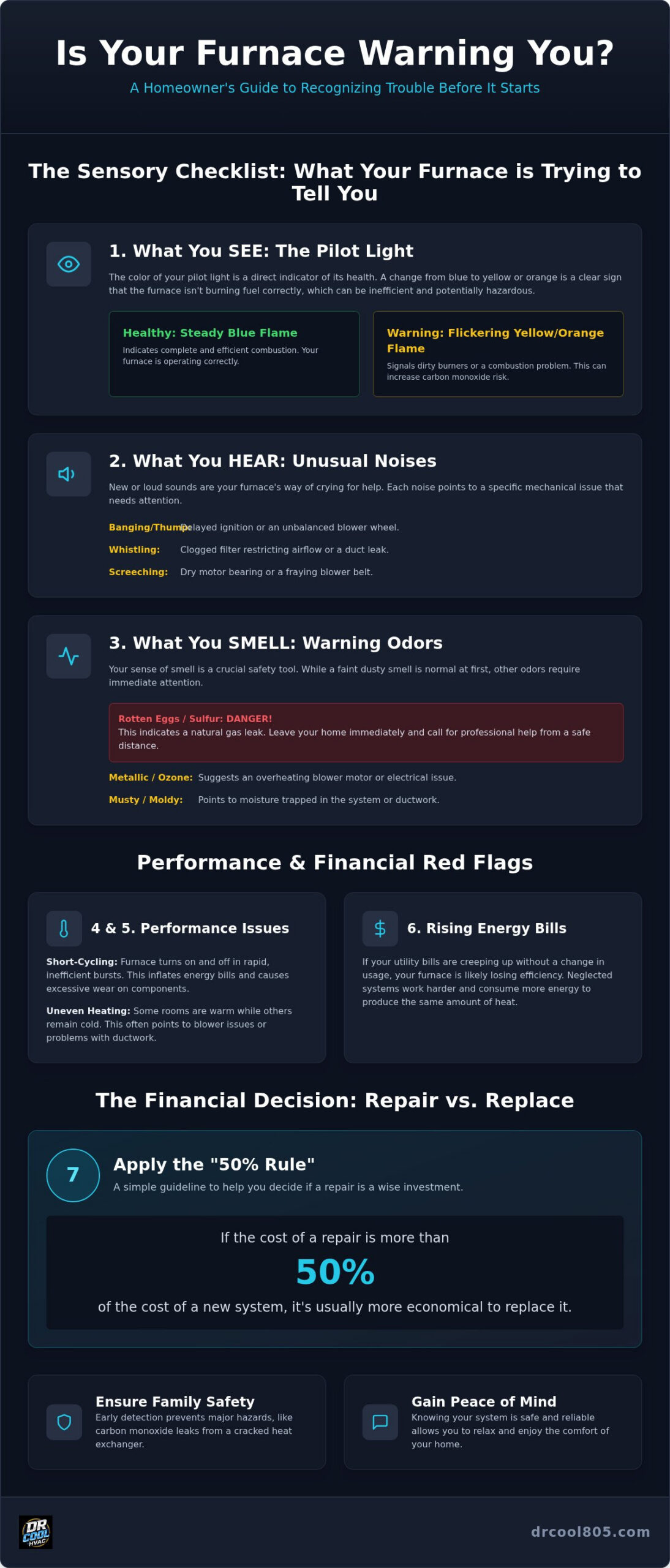
Your furnace doesn’t just stop working out of the blue. It usually spends weeks trying to tell you something is wrong through subtle changes in how it looks, sounds, and smells. Learning to translate this “furnace language” can save you from a cold night and an expensive emergency. One of the clearest visual signs furnace needs repair is the color of your pilot light. A healthy flame should be a crisp, steady blue. If you see a flickering yellow or orange glow, it often means the burners are dirty or the gas isn’t burning completely, which can increase carbon monoxide risks.
Deciphering Unusual Noises: Banging, Whistling, and Screeching
While every furnace makes some noise when it kicks on, “new” sounds are almost always a signal that a component is struggling. Banging or thumping sounds often point to delayed ignition, where gas builds up before lighting, or a blower wheel that has come out of balance. If you hear a sharp whistling, your system might be gasping for air due to a clogged filter or a leak in your ductwork. High-pitched screeching or chirping usually indicates that a motor bearing is dry or a blower belt is beginning to fray. If you’re hearing something new and unsettling, it’s always a good idea to schedule a professional inspection to catch these signs furnace needs repair before they lead to a total breakdown.
The “Nose Knows”: Smells That Require Immediate Attention
Your sense of smell is a powerful tool for home safety. When you first turn the heat on in November, a faint dusty smell is normal as settled particles burn off. However, a sharp, metallic, or ozone-like scent suggests that the blower motor is overheating. If you ever detect a “rotten egg” odor, this is the chemical added to natural gas to alert you to a leak. In this case, you should leave your home immediately and call for professional gas leak detection from a safe distance. Finally, musty or moldy odors often indicate that moisture is trapped in your system, which can compromise the indoor air quality in your Thousand Oaks home. Keeping your air clean and your system dry is essential for both your comfort and your health.
Performance Red Flags: When Your Comfort Starts to Fade
Sometimes the clearest signs furnace needs repair aren’t loud noises or sharp smells, but a slow decline in how comfortable your home feels. It’s frustrating to find yourself bundled in a blanket in your Fillmore living room while the kitchen feels like a sauna. This inconsistency usually means your system is struggling to maintain a steady rhythm. When your furnace can’t keep up with the setting on your thermostat, it’s often a signal that internal components are wearing down under the pressure of daily use.
In our 805 region, the fine, dry dust common to Southern California plays a bigger role than you might think. This dust can settle on sensitive internal sensors and filters, forcing the system to work harder just to provide a basic level of warmth. When the mechanics are strained by debris or age, you’ll notice a disconnect between the temperature on the wall and the actual air in the room. Paying attention to these performance shifts now can prevent a complete system failure during a cold January night.
Understanding Short-Cycling and Its Causes
A furnace that “restarts” every five minutes is a major repair red flag known as short-cycling. This happens when the system begins a heating cycle but shuts down prematurely, often because an internal safety switch detects overheating. Common culprits include a severely clogged air filter or a dirty flame sensor that can’t confirm the pilot is lit. This behavior is incredibly hard on your equipment and drains your wallet. It takes significantly more electricity to start a motor than to keep one running, so a cycling furnace will cause your energy bills to spike without ever actually making your home feel warm.
Uneven Heating and Airflow Issues
If you’re dealing with the “cold spot” mystery, where certain rooms stay chilly no matter how high you turn up the heat, the issue often lies with the blower motor. This motor is responsible for pushing conditioned air through your ductwork to the furthest corners of your house. When a blower motor or its capacitor begins to fail, the airflow becomes weak and sluggish. A technician can help you differentiate between a mechanical furnace issue and leaky ducts. If the air coming from your vents feels lukewarm or the flow is barely a whisper, your blower motor is likely reaching the end of its reliable lifespan and needs professional attention to restore balance to your home.
The Financial Signs: Repair vs. Replacement Decision Framework
Deciding whether to fix an old friend or invest in a new system is one of the most stressful parts of homeownership. You don’t want to throw good money after bad, but you also don’t want to replace a furnace that still has years of warmth left to give. Looking at the financial signs furnace needs repair helps take the guesswork out of the process and provides a clear path forward. It’s about finding the balance between your immediate budget and your long term peace of mind.
We often recommend the “50% Rule” as a helpful guide for our neighbors. If the cost of a single repair approaches half the value of a brand new system, it’s usually time to consider an upgrade rather than a temporary fix. Similarly, the frequency of those calls matters. If you’re seeing a technician more than once a season, those small, recurring bills are actually a leading indicator that a total system failure is on the horizon. However, a ten-year-old furnace in Simi Valley isn’t necessarily a goner. Many well-maintained units still have plenty of life left if they receive individualized care and timely part replacements.
Evaluating the “Repair or Replace” Math
To help visualize the best choice for your home, consider how repair costs stack up against the benefits of new equipment. Modern energy-efficient HVAC systems often pay for themselves over time through significantly lower monthly operating costs and reduced mechanical wear. Sometimes, a simple seasonal tune-up can reset the “age” clock on a well-built unit by clearing out debris and lubricating moving parts.
- Repair is likely best if: The unit is under 12 years old and the fix is a standard part replacement.
- Replacement is likely best if: Repair costs are high, the unit is over 15 years old, or your comfort is consistently low.
- The ROI Factor: New systems provide better air quality and lower utility usage from day one.
The Hidden Cost of Inefficiency
Take a moment to compare your energy bills from this January to last January in Oxnard. If your usage has spiked but your habits haven’t changed, your furnace is likely struggling with mechanical friction or “ghost draws” from failing electrical components. In Thousand Oaks, the local environment can lead to heavy dust buildup that chokes your system. When filters aren’t replaced regularly, the motor works overtime, leading to higher bills and unnecessary strain. If you’re seeing these signs furnace needs repair reflected in your bank statement, you can contact us for an honest diagnostic assessment to see which option truly protects your comfort and your budget.
Restoring Peace of Mind with DR COOL HVAC
Navigating the various signs furnace needs repair can feel like a lot to handle, especially when you just want your home to be a cozy sanctuary. At DR COOL HVAC, our philosophy is built on the idea that you shouldn’t have to be an expert to feel safe. We prioritize honest diagnostics that focus on your actual comfort and budget rather than high-pressure sales. As a locally owned contractor serving the 805 region, we treat every service call in Camarillo or Newbury Park as if we were helping a next-door neighbor. This personal attention is what sets us apart from large, clinical corporations that might see your home as just another number on a spreadsheet.
Our deep roots in the community mean we understand the specific challenges local heating systems face. From the fine dust of Simi Valley to the fluctuating humidity in Oxnard, we know how regional factors impact your equipment’s health. We believe that professional heating repair is about more than just turning a wrench; it’s about restoring the calm and reliability your family relies on during the cooler months. Our goal is to lead you from a state of uncertainty to a state of resolution with a steady, professional cadence.
The DR COOL Inspection Process
When we visit your home, we follow a methodical and transparent process designed to give you total clarity. We start by examining the heat exchanger for any safety risks and then move through a comprehensive checklist that includes testing your thermostat calibration and inspecting electrical connections. We don’t believe in “one size fits all” solutions. Instead, we provide you with clear, honest options. We’ll tell you exactly what is a “must fix” for safety or immediate operation and what is simply “recommended for efficiency.” This integrity-first approach ensures you always have the final say in your home’s care. To understand exactly what this process entails and why it matters for your family’s safety, read our professional furnace inspection guide covering every step of a thorough safety audit.
Scheduling Your Neighborly Service Visit
If you’ve noticed any of the signs furnace needs repair mentioned earlier, reaching out is simple. We proudly serve homeowners throughout Woodland Hills, Thousand Oaks, and the surrounding 805 areas. To make the most of your visit, we recommend clearing a small path to your furnace and jotting down any specific noises or odd behaviors you’ve noticed. This helps our technicians get straight to work on finding a solution. Your comfort shouldn’t be a source of stress. You can schedule your furnace inspection with DR COOL HVAC today and let us help you prepare for a safe, warm winter season.
Ready to Face the Cold with Total Confidence
Paying attention to how your system breathes and sounds is the best way to protect your home. You’ve learned how to spot the signs furnace needs repair, from odd noises and smells to rising energy bills. Catching these issues early isn’t just about saving money; it’s about making sure your family stays safe and warm all season long. We’re locally owned and operated right here in Thousand Oaks and Simi Valley. Our expert technicians specialize in energy-efficient heating solutions and provide neighborly service focused on integrity and honest diagnostics. We treat every situation as distinct and prioritize your peace of mind above all else.
Breathe easier and stay warmer, schedule your professional furnace repair with DR COOL HVAC today!
You don’t have to face the winter alone. We’re here to act as your steady, knowledgeable guide to ensure your household stays comfortable no matter how low the temperature drops.
Frequently Asked Questions
How do I know if my furnace noise is dangerous?
A loud boom when the furnace starts is often a sign of delayed ignition, which can cause physical stress to the heat exchanger over time. High-pitched screeching usually suggests a failing blower motor or a frayed belt. While some light clicking is normal during the start-up cycle, any sound that makes you jump or occurs repeatedly is a reason to call for a professional inspection.
Is it normal for my furnace to smell like it is burning when I first turn it on?
A faint, dusty smell is common when you first activate your heater in the fall. This is simply settled dust burning off the heat exchanger and should dissipate within half an hour. However, if the smell is metallic, like burning plastic, or smells like rotten eggs, you should turn the system off. These are clear signs furnace needs repair or immediate safety attention.
How much does a typical furnace repair cost in the 805 area?
The total cost for a repair in the Thousand Oaks or Simi Valley area depends entirely on the complexity of the issue and the specific parts required. A simple sensor cleaning is quite affordable, while replacing a blower motor involves more labor and higher material costs. We focus on providing honest diagnostics so you only pay for what your system actually needs to stay reliable.
Can a dirty air filter cause my furnace to stop working?
Yes, a clogged filter is one of the most common reasons for a system shutdown. When airflow is blocked, the internal temperature rises quickly, triggering a safety limit switch that turns the furnace off to prevent damage. Frequently changing your filters helps you avoid these unnecessary service calls and keeps your monthly energy bills much lower during the winter months.
What color should my furnace pilot light be?
Your pilot light should always be a crisp, steady blue color. This indicates that the gas is burning efficiently and completely. If the flame appears yellow or orange, it’s a sign of incomplete combustion, which can lead to higher carbon monoxide levels. A flickering or discolored flame is one of the primary signs furnace needs repair to ensure your family stays safe and warm.
How often should I have my furnace inspected in Simi Valley?
We recommend a professional inspection once a year, preferably before you need to turn the heat on for the season. In Simi Valley, the dry, dusty air can lead to buildup inside your unit even if you don’t use it for several months. Regular maintenance catches small stresses before they become major failures, extending the overall lifespan of your heating equipment.
Why is my furnace blowing cold air even when the heat is on?
Cold air usually means there’s a disconnect between the burner and the blower fan. Your thermostat might be set to “On” instead of “Auto,” which keeps the fan running even when the heat isn’t being produced. Other causes include a pilot light that has gone out or a faulty flame sensor. It’s a frustrating issue, but it’s often a straightforward fix for a professional. For a deeper look at each possible cause and what you can do about it, see our complete guide on why your furnace is blowing cold air and how to troubleshoot it.
When is it more cost-effective to replace my furnace instead of repairing it?
It’s usually more cost-effective to replace your unit if the repair cost is more than half the price of a new system. You should also consider the age of your furnace. If it’s over 15 years old and requiring frequent fixes, a modern, energy-efficient model will likely save you more money on monthly utilities and future repairs in the long run than a temporary fix.