
Imagine waking up on a crisp morning in Thousand Oaks, reaching for the thermostat, and realizing the house feels more like a refrigerator than a home. It’s a sinking feeling that usually happens right when the 805 area gets its first real cold snap of the season. When your system fails, finding reliable central heat repair becomes your top priority, but the stress of high energy bills or the fear of a dishonest quote can make a cold house feel even colder.
We understand that your home is your sanctuary, and a broken heater is more than just an inconvenience; it’s a disruption to your family’s peace of mind. You deserve to know exactly what’s happening with your equipment without feeling pressured into a replacement you might not need. This guide will help you identify common symptoms, walk you through simple troubleshooting steps, and explain how a professional restores your comfort. We’ll also explore the industry’s $5,000 rule to help you decide on the best path forward and look at how the new 2026 environmental regulations might affect your system’s long-term health.
Key Takeaways
- Learn how to spot early warning signs like strange noises and how a simple air filter check can often save you from an unnecessary service call.
- Understand why your thermostat or ignition system might be the hidden cause behind your home’s chill and when it’s time to seek professional central heat repair.
- Discover how to apply the industry “$5,000 Rule” to help you make a confident, cost-effective decision between fixing your current unit or investing in a new one.
- Find out how upcoming 2026 efficiency regulations and your unit’s AFUE rating impact your long-term energy savings and home comfort.
- See why local 805 expertise ensures your heating system is handled with neighborly care and a deep understanding of our unique regional climate.
Recognizing the Signs: When Your Central Heating System Needs Professional Repair
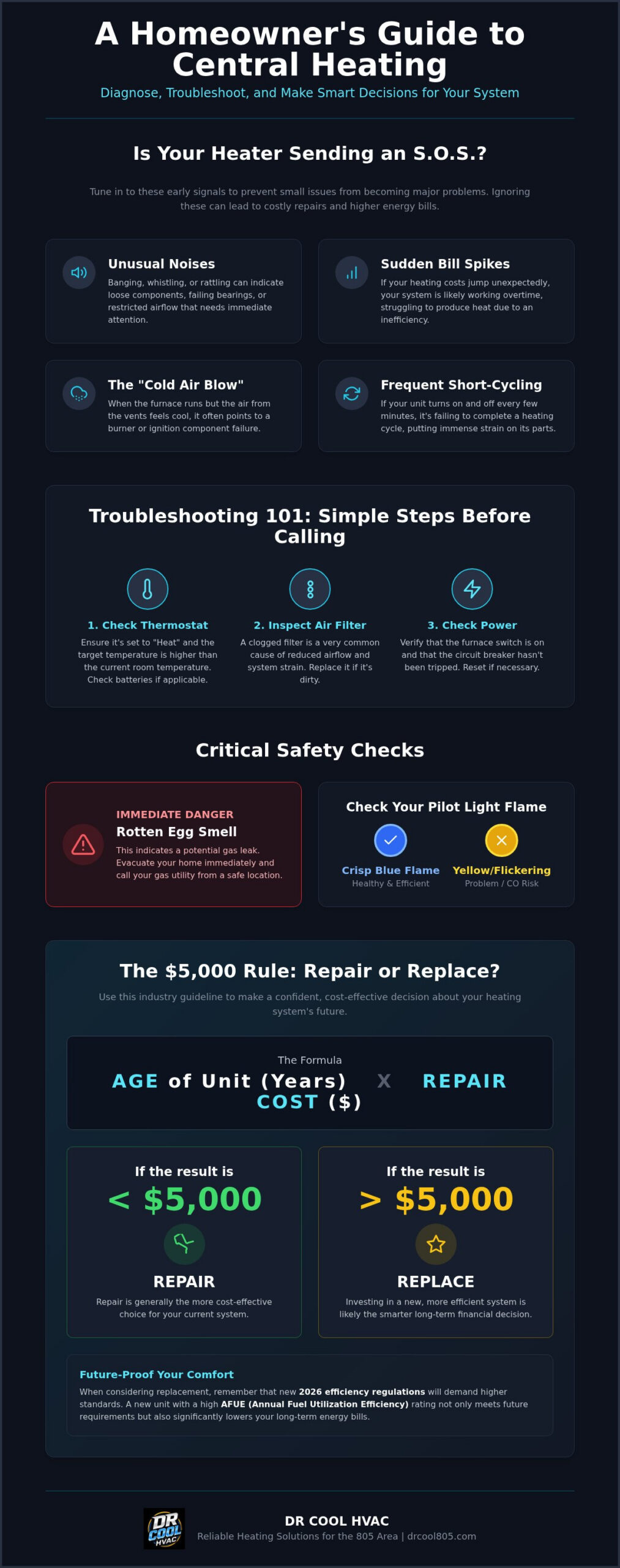
Your heating system usually speaks to you long before it stops working entirely. Tuning in to these early signals can be the difference between a simple fix and a more involved project. If you notice your home isn’t quite as cozy as it used to be, it’s often a sign that you need professional central heat repair to restore efficiency and safety. Ignoring small changes can lead to unnecessary wear on your equipment, so staying observant is the first step in maintaining a comfortable household.
- Unusual noises: Banging, whistling, or rattling coming from your vents often indicate loose components, failing bearings, or restricted airflow that needs attention.
- Energy bill spikes: If your heating costs jump unexpectedly without a change in weather, your system is likely struggling to produce heat, causing it to run longer than it should.
- The “cold air blow”: This occurs when the furnace runs but the air coming through the registers lacks warmth. This often points to a burner issue or a failing ignition component. If you’re experiencing this issue, our detailed guide on furnace blowing cold air troubleshooting and easy fixes can help you identify the root cause.
- Short-cycling: If your unit turns on and off every few minutes, it’s failing to complete a full heating cycle. This puts immense strain on the motor and electrical parts.
Strange Smells and Safety Concerns
When you first turn on the heat in the fall, a faint “burning dust” smell is common as the unit clears out particles that settled over the summer. However, a sharp, rotten egg odor is a warning sign of a gas leak and requires you to act quickly. You should also check your furnace’s pilot light if it’s visible. A healthy flame is crisp and blue. A yellow or flickering flame suggests incomplete combustion, which can lead to carbon monoxide buildup. Because your family’s safety is the priority, every 805 home should be equipped with working carbon monoxide detectors to provide peace of mind while the heater is running.
Inconsistent Temperatures Across Different Rooms
It’s frustrating when the living room is toasty but the bedrooms feel like an icebox. While you might suspect the furnace itself, these cold spots are often caused by ductwork leaks that allow warm air to escape into the attic or crawlspace. The blower motor also plays a critical role in distributing air. If the motor is weakening, it won’t have the strength to push air to the furthest corners of your Simi Valley home. Addressing these airflow issues through expert central heat repair ensures that every room stays inviting, regardless of how low the temperature drops outside. This balanced approach helps your system run more efficiently and extends its overall lifespan.
Common Culprits: What Usually Goes Wrong with Central Heat?
When your home loses its warmth, it’s natural to feel a bit overwhelmed by the complexity of the machinery tucked away in your closet or attic. Most issues we encounter during a central heat repair call actually stem from a handful of predictable components that work hard every winter. By understanding these common culprits, you can better describe what’s happening to a technician and regain a sense of control over your home’s comfort.
Ignition system failures are among the most frequent reasons a furnace stops producing heat. If you have an older unit, the pilot light might have simply blown out due to a draft or a dirty orifice. Newer systems use electronic igniters that can crack or wear out over time, preventing the burners from lighting. If you hear a persistent clicking sound followed by silence, your igniter is likely struggling to do its job. Mechanical wear on the blower motor or the belt that drives it can also cause issues; a worn belt might squeal, while a failing motor often results in weak airflow or a total system shutdown.
The Role of the Heat Exchanger
A heat exchanger is a set of metal tubes or coils that transfers heat from the combustion process to the air inside your home while keeping dangerous exhaust gases separate. This component acts as the heart of your furnace, but it’s under constant stress from expanding and contracting as it heats and cools. Over many years, this cycle can lead to small cracks. These cracks are a significant safety concern because they allow combustion byproducts to enter your living space. If you suspect your system is losing efficiency or producing odd smells, having a professional inspect your heating system can provide the clarity you need to keep your family safe.
Thermostat Disconnects and Calibration
Sometimes the problem isn’t with the furnace at all, but with the “brain” telling it what to do. A thermostat that has lost its connection or calibration will leave you in the cold even if the rest of the system is perfect. Before assuming you need a major fix, check the batteries; a low battery can cause the screen to look normal while the internal relay fails to trigger the heat. There’s also a big difference between a broken thermostat and one that is simply misconfigured. We often see smart thermostats that aren’t fully compatible with older central heat units, leading to communication errors that prevent the system from starting. Ensuring your thermostat is properly synced is a simple yet vital part of maintaining a reliable home environment.
The $5,000 Rule: Deciding Between Central Heat Repair and System Replacement
Deciding whether to keep fixing an aging furnace or invest in a new one is a major decision for any homeowner. It’s about finding the balance between immediate savings and long-term reliability. A helpful industry guideline we often share is the “$5,000 Rule.” To use it, you simply multiply the age of your system in years by the estimated cost of the central heat repair. If the total exceeds $5,000, it’s usually time to consider a replacement. For example, if a 12-year-old system needs a $600 fix, the result is $7,200. In this case, the math suggests that a new unit is a wiser investment for your home’s future.
Beyond the calculation, you should consider your unit’s AFUE rating, which measures how efficiently it turns fuel into heat. Older systems often have a rating around 80%, meaning 20% of the energy you pay for is wasted. Modern high-efficiency units can reach 95% or higher, which significantly lowers monthly bills throughout the 805 area. You also have to think about the availability of parts. If your furnace is a discontinued model, finding a specific control board or motor can become a costly scavenger hunt that leaves your family in the cold for days while you wait for shipping.
When Repair is the Logical Choice
If your system is less than 10 years old and has been serviced regularly, a repair is often the best path. Minor component failures, such as a faulty capacitor, a dirty flame sensor, or a worn igniter, are routine fixes that don’t justify the cost of a full replacement. We generally recommend sticking with your current unit if the repair bill is less than 30% of what a new system would cost. It’s about protecting your budget while ensuring your home stays warm. A well-maintained system can often provide several more years of faithful service after a simple central heat repair.
Signs It Is Time for a Full Replacement
There are times when even the best maintenance can’t overcome the toll of time. If your furnace is over 15 years old and develops a cracked heat exchanger, the safety risks and high costs make a replacement the responsible choice. Frequent breakdowns are another clear signal. If you’ve called for service more than twice in the last two years, your system is telling you it’s reaching the end of its lifespan. Upgrading to a newer model not only restores your peace of mind but also prepares your home for the higher efficiency standards taking effect in 2026. This is especially true for families looking to lower their Oxnard energy bills over the long term.
Troubleshooting 101: Simple Steps to Take Before Calling a Heating Expert
Discovering that your heater isn’t working can be a stressful experience, especially when the temperature starts to dip in the evening. Before you worry about the cost of a professional central heat repair, it’s helpful to realize that some issues have very simple fixes. We always encourage our neighbors in the 805 to perform a few basic checks first. This not only gives you a sense of control but can also save you the time and expense of a service visit for a minor oversight.
Start by walking over to your thermostat. It sounds basic, but ensure the system is set to “Heat” rather than “Auto” or “Cool,” and verify that the set temperature is at least five degrees above the current room temperature. Next, take a quick trip to your electrical panel. A power surge can sometimes trip the heater’s switch without affecting the rest of the house. If the breaker has moved to the middle position, flip it all the way off and then back on. Finally, walk through your rooms to ensure all registers and vents are open. Sometimes a new piece of furniture or a thick rug can accidentally block airflow, making the system work much harder than necessary.
The Power of a Clean Filter
A dirty air filter is the most common cause of airflow issues we see in Simi Valley and Thousand Oaks. When the filter is clogged with dust and pet dander, your furnace has to struggle to pull in air. This causes the internal components to overheat, which often triggers a safety switch that shuts the entire system down. In our region, where wind and dust are common, we recommend checking your filter every 30 to 60 days. A $20 filter change can often prevent a $500 repair bill. Keeping this simple component clean is the easiest way to ensure your system runs efficiently all season long.
Resetting Your System Safely
Modern heating units rely on electronic control boards that can sometimes “glitch” after a power flicker. You can try a basic reset by turning the power off at the unit or the breaker, waiting about thirty seconds, and then turning it back on. This allows the internal computer to recalibrate. If you have a heat pump, take a moment to step outside and ensure the outdoor unit isn’t buried under fallen leaves or blocked by debris. However, if you smell gas, hear loud mechanical grinding, or if the system fails to start after one reset attempt, it’s time to stop. For your safety and the health of your equipment, contact a professional for central heat repair to get to the bottom of the issue without taking unnecessary risks.
Why 805 Homeowners Trust DR COOL HVAC for Reliable Heating Solutions
Home maintenance often feels like a gamble when you don’t know who is coming through your front door. At DR COOL HVAC, we’ve spent years building deep roots throughout Thousand Oaks, Simi Valley, and the entire 805 region. We aren’t a distant, faceless corporation. We’re your neighbors. This means we treat every central heat repair with the same care and integrity we’d give our own families. Our primary goal is to provide more than just a functional furnace; we want to restore the security that makes your house feel like a sanctuary. You can always expect honest advice and a clear explanation of exactly what’s happening with your equipment.
We believe that transparency is the foundation of trust. Before any work begins, we walk you through the situation in plain English, avoiding technical jargon that only serves to confuse. You’ll understand the state of your system, the reason for the failure, and the most reliable path to a resolution. This neighborly approach prioritizes your peace of mind over a quick sale. By acting as a dedicated guide, we help you manage the stress of an unexpected breakdown with a steady and knowledgeable presence.
Our Professional Inspection and Repair Process
When we visit your home in Camarillo or Fillmore, the process is methodical and unhurried. We don’t just swap out parts and hope for the best. Instead, we perform a comprehensive diagnostic to find the root cause of the issue. We look at the entire system, from the electrical connections to the indoor air quality, to ensure your heater isn’t just running, but running safely. This focus on long-term health ensures that once your central heat repair is complete, your system operates at its peak efficiency. We take the time to show you our findings so you can make an informed decision about your home’s comfort without any pressure.
Ready to Restore Your Comfort?
It’s time to stop shivering through the night and start enjoying your home again. Scheduling a visit is simple and designed to fit into your busy 805 lifestyle. There’s a specific kind of relief that comes from knowing a professional has inspected your heater and confirmed it’s safe for your family. If you’re ready to get your system back on track, contact DR COOL HVAC today. We’re here to be your helpful partner, providing the individualized attention you deserve to keep the winter chill outside where it belongs.
A Warmer, Safer Home for Your Family
Maintaining a comfortable home doesn’t have to be a source of stress. By staying alert to the early signs of system wear and applying practical guides like the $5,000 rule, you can make confident decisions about your equipment’s future. Whether you’ve resolved a minor airflow issue with a fresh filter or identified a more complex mechanical failure, taking action early protects both your budget and your family’s safety.
When the DIY steps aren’t enough, you don’t have to face the cold alone. As a locally owned and operated business in the 805, we take pride in offering neighborly service that prioritizes your peace of mind. Our team brings specialized expertise to every central heat repair in Simi Valley, Thousand Oaks, and Oxnard, ensuring your system is handled with integrity and care. We’re here to be your trusted guide, helping you navigate repair choices with transparent advice and reliable solutions.
Ready to get your home back to its cozy best? You can Schedule Your Central Heat Repair with DR COOL HVAC today and let us handle the rest. We look forward to restoring your comfort and making sure your household stays warm all season long.
Frequently Asked Questions
How much does a typical central heat repair cost in the 805 area?
Costs for central heat repair depend on the complexity of the issue and the age of your system. Minor fixes involving sensors or thermostats are generally the most affordable. Moderate repairs like blower motors or control boards involve more labor and parts. For major issues like a cracked heat exchanger, the investment can be substantial. We always provide a clear, transparent explanation of costs before any work begins so you can make an informed decision.
Why is my furnace blowing cold air even when the heat is turned on?
Cold air often signals an issue with the ignition system or the pilot light. If the furnace can’t light the fuel, it will still blow air to try and circulate heat, but that air remains at room temperature. A dirty flame sensor or a tripped safety switch might also be the culprit. Checking these components is a standard part of a professional central heat repair visit to ensure your home returns to its cozy state. For a deeper dive into diagnosing this specific problem, see our complete guide on why your furnace is blowing cold air and how to fix it.
Can I repair my own central heating system?
You can safely handle basic maintenance like changing air filters or replacing thermostat batteries. However, most repairs involve high-voltage electricity or natural gas lines. Working on these components without proper training can be dangerous and may void your equipment warranty. For your safety and peace of mind, it’s best to let a professional handle any internal mechanical issues or gas-related adjustments to ensure the system operates correctly.
How long does a standard central heating system last?
Most well-maintained central heating systems have a lifespan of 15 to 20 years. Factors like how often you change the filter and whether you skip annual inspections play a huge role in its longevity. In our 805 climate, systems often last on the longer side because they aren’t running as hard as those in snowy regions. However, after the 15-year mark, parts often become harder to find and efficiency begins to drop significantly.
What is the most common reason for a heater to stop working?
A dirty air filter is the most frequent reason for a system failure. When airflow is restricted, the furnace works harder and can overheat, causing it to shut down for safety. Thermostat malfunctions and dead batteries are also very common. These simple issues are often mistaken for major mechanical failures. Regularly checking these basics can prevent many unexpected breakdowns during a cold snap in Thousand Oaks or Simi Valley.
Is it worth repairing a 20-year-old furnace?
Repairing a 20-year-old furnace is usually not recommended if the fix is expensive. At this age, the system has likely reached the end of its reliable lifespan and operates at a much lower efficiency than modern units. You should consider the $5,000 rule mentioned earlier in this guide. Investing in a new high-efficiency system often saves you more on monthly energy bills and provides better safety for your family over the long term.
How often should I have my central heating system inspected?
We recommend having your system inspected once a year, ideally in the late summer or early fall. This allows a technician to clean the components and identify potential problems before you actually need to turn the heat on. Regular check-ups help maintain your warranty and ensure the unit is running as efficiently as possible. It’s a small step that provides significant peace of mind when the first chilly night arrives.
What should I do if I smell gas coming from my heater?
If you smell a strong odor of rotten eggs, you should leave your home immediately and call the gas company or 911 from a safe distance. Do not turn on any lights, use a phone inside the house, or try to shut off the gas yourself. Once the authorities have confirmed the area is safe, you can contact a professional to inspect the unit and perform the necessary repairs to ensure your home is secure.
